
Freestanding vs. Built-In Bathtub: Installation Costs, Space, and Cleaning
You are standing in a showroom, looking at a gleaming white freestanding tub on a little pedestal of lights. It looks like a spa. Then you glance at the plain alcove tub next to it, the one that looks like every tub you have ever bathed in, and it looks a bit tired. The photo in your head says freestanding. The tape measure in your bathroom might say something else.
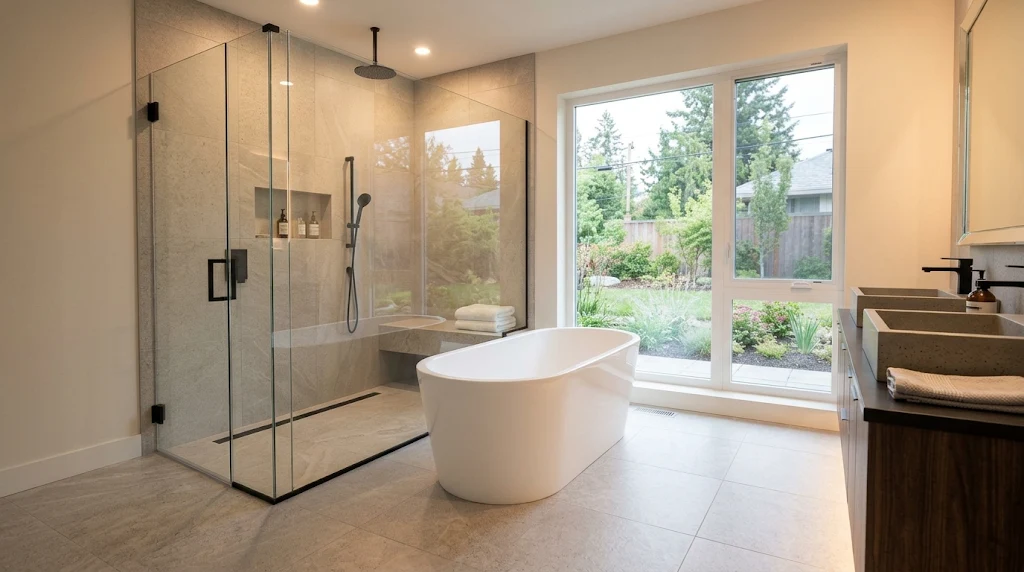
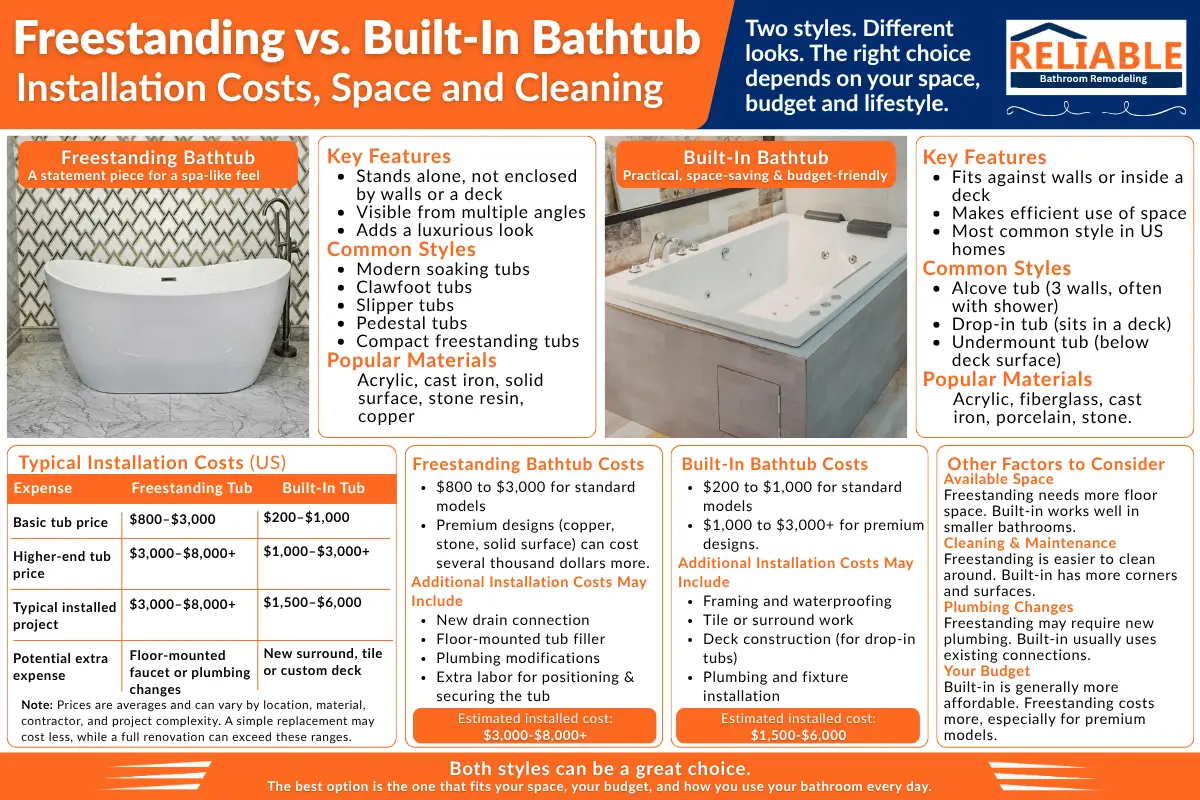
When comparing a freestanding vs built-in tub, the better choice depends on your bathroom layout, budget, and installation needs. Both styles are good, but they serve different purposes. A freestanding tub gives you a design centerpiece and a deep soak, but it requires more room, careful plumbing planning, and adequate floor support. A built-in tub fits against walls, generally costs less to install, and doubles as a shower, but it makes less of a design statement.
This guide compares both bathtub styles on cost, space, plumbing, floor load, and cleaning, so you can make your decision based on facts rather than appearances. Prices and sources were checked in November 2026.
Quick answer
Pick a freestanding tub if you have a roomy bathroom, a solid floor and a budget for plumbing. Pick a built-in tub if you want a shower over the tub, tighter space and lower installation costs. According to Block Renovation, a freestanding install can cost $800 to $3,000 or more in labor than a built-in because the drain often moves and the floor carries the full weight. Not every source agrees on the gap, and the article explains why.
Side by side at a glance
| Factor | Freestanding tub | Built-in tub (alcove, drop-in or undermount) |
|---|---|---|
| Installation cost | Often higher, mostly in labor, drain and floor work | Often lower, usually reuses existing plumbing |
| Space needed | More. Needs open clearance around it | Less. Fits a standard alcove, often about 60 by 30 inches |
| Floor load | Heavy materials may need reinforcement | Supported by surrounding framed walls |
| Plumbing | Floor-mounted or wall-mounted filler, visible lines, center drain | Supply lines hidden in the wall, drain at one end |
| Cleaning | Open all around, so more floor to clean, but less wall surface | More wall and caulk surface, hidden corners |
| Storage | None built in | Ledges and shelves possible |
| Shower use | Awkward, usually needs extra work | Easy to add a shower over the tub |
The rest of this guide explains each row, with the numbers where I could find them.
What counts as a built-in tub
A built-in tub is attached to the room’s structure instead of standing on its own. The most common version is an alcove tub that fits between three walls, which is the standard tub and shower combo. Drop-in tubs sit inside a built platform, and undermount versions are set below a countertop or deck. All of them hide at least some of the plumbing and use the surrounding framing for support.
A freestanding tub, by contrast, sits on the floor with no surround. Because nothing hides the supply lines, drain or weight, the project becomes about more than the tub. Block Renovation puts it plainly: the tub itself is just one line item.
Installation costs
Start with the tub itself. Material drives price, and it also drives weight, which matters later. These ranges are from Block Renovation’s 2026 guide for freestanding tubs.
| Freestanding tub material | Tub cost (approx.) | What to know |
|---|---|---|
| Acrylic | $500 to $2,500 | Lightweight and affordable, less durable over time |
| Fiberglass | $400 to $1,500 | Budget-friendly, scratches and fades more easily |
| Cast iron | $1,500 to $5,000 | Very durable, holds heat, very heavy |
| Stone resin | $2,000 to $8,000 | Dense and premium, heaviest category with cast iron |
| Solid surface | $2,500 to $7,000 | Matte finish, repairable if scratched |
| Copper | $3,000 to $10,000 or more | Distinctive, needs specific care |
Then comes labor and the extras. Block Renovation says labor for a straightforward freestanding install, with the same footprint and the drain already in the right place, runs $200 to $1,000, but most real installs land between $800 and $3,000. The items that push the number up are the ones nobody sees in the showroom:
| Extra cost | Typical range | Why it happens |
|---|---|---|
| Drain relocation, wood-framed floor | $500 to $1,500 | Freestanding tubs usually drain from the center, not at one end |
| Drain relocation, concrete slab | $1,000 to $3,000 or more | The slab must be broken, re-plumbed and patched |
| Floor-mounted faucet (fixture) | $300 to $2,000 or more | No deck or wall to mount a faucet on |
| Supply rough-in through the floor | $400 to $900 | Lines must be added where none existed |
| Floor reinforcement | $300 to $1,200 | Cast iron or stone resin on a wood floor |
| Flooring repair where the old tub sat | $200 to $600 patch, $800 to $3,500 or more for a full floor | A freestanding tub does not cover the gap |
| Larger water heater, if needed | $800 to $2,500 | Some tubs hold more than a standard tank supplies |
Now the built-in side. Aquatica reports that a standard bathtub installation typically runs $2,300 to $5,700 including the tub and labor, and that a simple alcove replacement can start around $1,000 when the plumbing and layout stay the same. The same guide notes that cost rises when the drain location changes, when a built-in becomes a freestanding tub, or when a floor-mounted filler is added.
Why sources disagree on the gap
Fixr compares a 5-foot acrylic soaking tub installed at about $1,200 for freestanding versus about $1,350 for built-in, which is almost a wash. Block Renovation, meanwhile, says a freestanding install usually costs $800 to $3,000 or more in labor than a built-in. My read is that both can be true. If the freestanding tub replaces another freestanding tub, or lands exactly over an existing drain, the gap nearly disappears. If you convert from an alcove to a freestanding setup, the extra plumbing and floor work create the gap. So the honest answer is that the type of change matters more than the type of tub.
Space and clearance
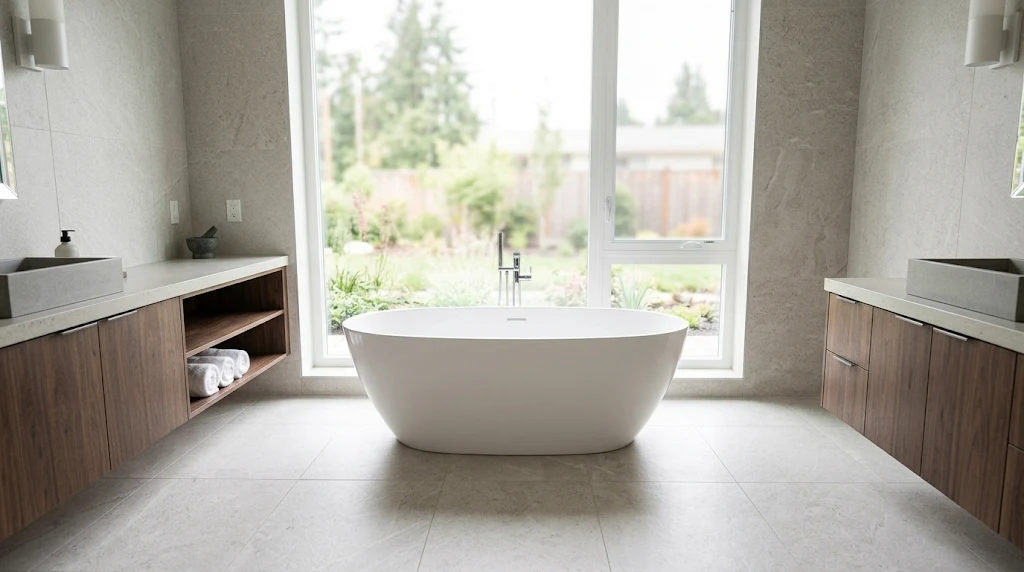
A built-in tub fits a defined box. A standard alcove tub is about 60 inches long and 30 inches wide, and the walls do the rest of the work. A freestanding tub may be 60 to 72 inches long, and it needs breathing room on every side, for walking, for cleaning and for the way it looks.
- Retailer and designer guides commonly suggest roughly 6 to 12 inches of clearance around a freestanding tub, and more where the room allows. Guidance varies, and some call for 8 inches all around.
- Put the tub too close to a wall and you lose the design benefit and create a cleaning problem.
- Block Renovation says freestanding tubs tend to add value in bathrooms of roughly 80 square feet or more, where they can be showcased without crowding.
- In a small bathroom, a built-in tub often leaves room for a vanity and storage, while a freestanding tub can eat circulation space.
Whatever the sizing guides say, measure your own room and mark the tub’s footprint, with its clearance, on the floor with tape. Walk around it. If it feels tight in tape, it will feel tighter in porcelain.
Floor weight and plumbing
Weight is the part people forget. Block Renovation says cast iron and stone resin tubs filled with water can weigh 500 to 900 pounds or more, and most residential floors, especially older ones and upper-floor bathrooms, are not designed for that load concentrated in one spot. It recommends having a contractor assess the subfloor and joists, with reinforcement running $300 to $1,200 if needed. Angi also notes that many installations require structural reinforcement of the floor before the tub is placed and filled. Lighter acrylic or solid surface tubs usually avoid this. On a concrete slab, weight is not a concern, but drain moves are harder.
Plumbing is the second surprise. An alcove tub drains at one end into the existing rough plumbing, with supply lines inside the wall. A freestanding tub has a drain that is rarely in the same spot, and its supply lines are visible. You can choose:
- A floor-mounted filler, which looks sleek but needs supply lines run through the floor.
- A freestanding faucet column, with the same floor rough-in requirement.
- A wall-mounted filler, which is usually simpler to connect, but its position must be fixed before the walls close.
The most useful rule here is also the simplest: confirm where your drain is before you buy the tub. Drain location varies by model, and it is the biggest single lever on installation cost.
Cleaning and maintenance
Cleaning depends on what surrounds the tub. Fixr notes that alcove tubs with built-in showers have more wall space to clean than freestanding tubs, though a handheld showerhead can make rinsing easier. A freestanding tub is open on all sides, so there is less wall to scrub, but there is more floor to wipe around and beneath it. Block Renovation adds that the space around a freestanding tub collects dust, hair and moisture and needs deliberate cleaning, and that a gap under the tub too narrow to reach becomes a long-term problem.
| Cleaning issue | Freestanding tub | Built-in tub |
|---|---|---|
| Surfaces to wipe | Tub exterior and the floor around and beneath it | Tub, surround walls and any shower area |
| Soap scum | Mainly on the tub, less on walls | More on the tile or surround walls in a shower combo |
| Caulk and grout | Floor grout near the base | A caulk line where the tub meets the wall, which needs upkeep over time |
| Hidden spots | Underneath and behind, if the gap is small | Corners and edges where the tub meets the surround |
| Material care | Copper needs special products, cast iron can chip, stone resin dislikes abrasives | Acrylic and fiberglass scratch with harsh scrubbing |
The caulk and grout lines in this table are general bathroom practice, not from a single source, so check your tub’s manufacturer for its care instructions before choosing a cleaner. In both cases, a routine matters more than the style. A freestanding tub on a pedestal with a few inches to the floor is easy to mop. A freestanding tub with a tiny gap is not.
Daily use, comfort and hot water
Think about how the tub will actually be used. Block Renovation says the average alcove tub holds 40 to 60 gallons, while many freestanding models hold 60 to 80 and some designer models exceed 100. That has two consequences. A larger tub uses more water, roughly $0.35 to $0.50 per 70-gallon fill at average U.S. rates, according to Block Renovation. And a standard 40 to 50 gallon water heater may run out before a big tub is full. Upgrading runs $800 to $2,500, though it is not always needed. Fill time matters too, since a large freestanding tub can take 15 to 25 minutes to fill at average pressure, losing heat as it does.
- Showers: a built-in tub is easy to turn into a shower. A freestanding tub is mainly for soaking. If you shower daily, consider a separate shower, such as a step-free shower alternative.
- Kids and pets: high walls on a built-in tub with a shower curtain or glass are practical. A deep freestanding tub can be harder to step into for little ones.
- Storage: a built-in tub can include ledges and shelves for supplies. Freestanding tubs offer none, so you need a side table or tray.
- Accessibility: higher rims on either style can be hard to step over. If mobility is a concern, ask about lower-profile designs.
Resale and design
A freestanding tub looks like an upgrade, and that is part of its appeal. Whether it pays back is less clear. Block Renovation says a freestanding tub alone will not move resale value much, and that it tends to help where the room is large, the market expects premium finishes and the rest of the bathroom matches. It can hurt in small rooms, in markets where buyers value practicality, or when the cost far exceeds what comparable homes have.
Cost-wise, a statement tub is a want, not a need, and it is wise to know that before you spend. If you want to see how tubs look in real rooms, browse the bathroom photo gallery and compare layouts.
How to choose
- ☐Choose freestanding if the room is large enough for clearance on every side.
- ☐Choose freestanding if your floor can carry the weight, or you are happy to reinforce it.
- ☐Choose freestanding if you mainly soak and have a separate shower.
- ☐Choose built-in if you need a tub and shower in one space.
- ☐Choose built-in if the bathroom is small or you want the lowest installation cost.
- ☐Choose built-in if you want a ledge or shelf for storage.
- ☐Whichever you pick, locate the drain and supply lines before you buy the tub.
A word on the “while we’re at it” trap. Choosing a freestanding tub often leads to a new faucet, a new floor and new lighting, and each add-on brings its own cost. Set the full scope before you order the tub, not after. For more on typical prices, see the price ranges to plan around, and for more on the work involved, the tub and plumbing installation services list.

Frequently asked questions
Is a freestanding tub more expensive than a built-in tub?
Usually the installation is, especially if the drain moves, the floor needs reinforcement or a floor-mounted faucet is added. Block Renovation puts the extra labor at $800 to $3,000 or more, while Fixr shows a smaller gap for a simple acrylic swap. The tub itself can range from $400 to $10,000 or more.
How much space does a freestanding tub need?
Plan for the tub’s own footprint, often 60 to 72 inches long, plus roughly 6 to 12 inches of clearance around it according to common design guidance. Larger rooms, about 80 square feet or more, show the tub off best.
Do freestanding tubs need floor reinforcement?
Sometimes. Heavy cast iron and stone resin tubs can weigh 500 to 900 pounds or more when filled, so ask a contractor to check the joists. Lighter acrylic tubs usually do not need it.
Are freestanding tubs harder to clean?
Not necessarily. There is less wall to scrub, but more floor to clean around and underneath the tub. A gap that is too narrow to reach can make cleaning harder.
Can I put a shower over a freestanding tub?
It is possible with a tub-and-shower fixture or a ceiling-mounted setup, but it complicates the plumbing and usually needs a surround to contain the spray. Most people who shower daily choose a built-in tub or a separate shower.
Do I need a permit to install a tub?
It depends on the scope. A like-for-like swap often does not need one, while moving the drain or supply lines or adding electrical usually does. Rules vary by city, so ask your local building department. This is general information, not legal advice.
Final thoughts
A freestanding tub is a beautiful choice when you have the room, the floor and the budget for the plumbing. A built-in tub is a practical choice when you want a shower, tighter space and a simpler install. The tub is only one piece of the project. The drain, the floor and the clearance decide whether the dream tub is an easy yes or an expensive surprise.
If you remember one thing, make it this: find the drain first, and ask a pro about the floor. Those two checks prevent most of the surprises. If you have more questions on planning, the homeowner planning questions may help, and you can check the service coverage page for availability. Sources checked November 2026.
Not sure which tub fits your bathroom?
Tell Reliable Bathroom Remodeling about your room size and your plumbing, and ask for a free estimate. Ask for freestanding and built-in options priced side by side, including drain and floor work.