

How to Choose a Bathroom Remodeling Contractor: 12 Questions to Ask
Three estimates sit on the table. Two are within a few hundred dollars of each other. The third is $3,000 lower, and the person who wrote it was friendly, quick, and happy to start next week. Your brain does the math before you do. That gap feels like a gift.
Sometimes it is. Often it is a missing line item, a thin insurance policy, or a plan to ask for more money halfway through. The tricky part is that a lower price is easy to see, but the risks behind it are not. Good questions make those risks visible.
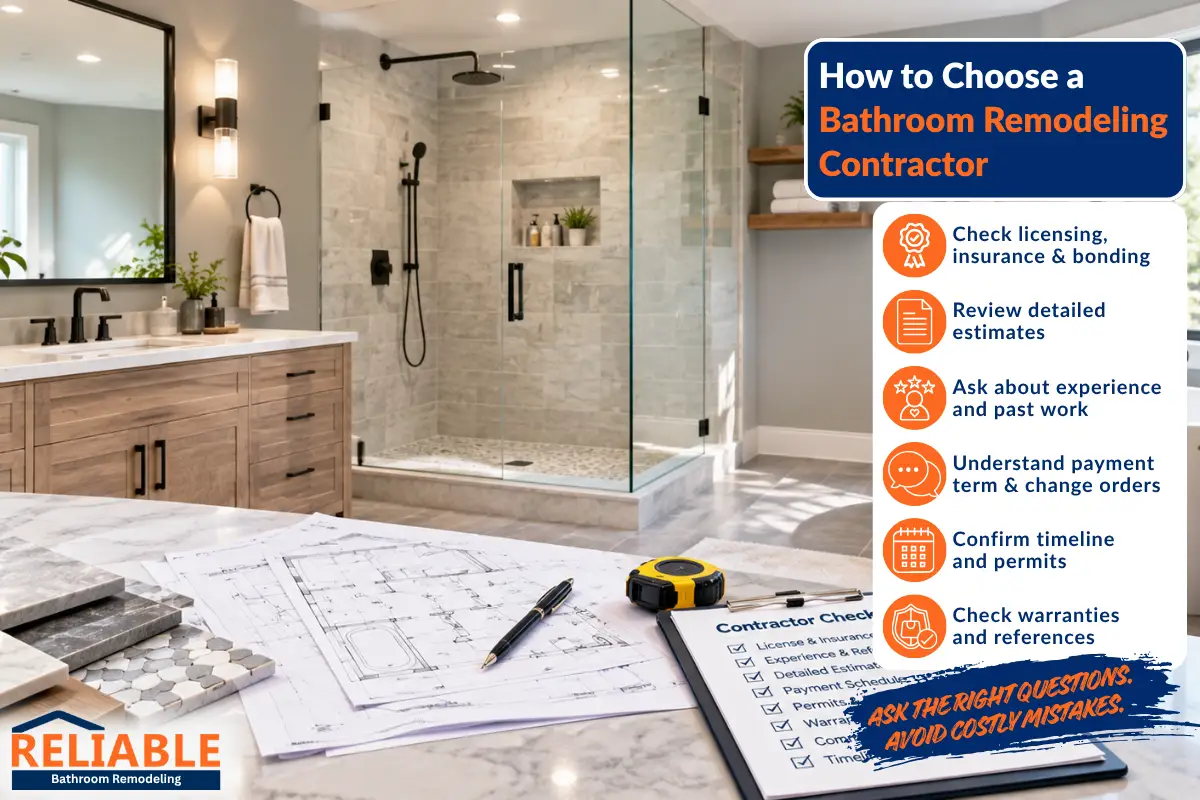
Knowing how to choose a bathroom remodeling contractor means looking beyond the estimate and asking the right questions before signing a contract. This guide covers 12 essential questions, explains what a solid answer sounds like, and shows you where to verify it.

Quick answer
Before you compare prices, confirm four things: the contractor is properly licensed or registered where you live and is insured, has finished bathrooms like yours, will put everything in a detailed written contract, and ties payments to finished work. The Illinois Attorney General says about 20 percent of the 20,000 or more complaints it gets each year involve disputes with home repair contractors, and the Federal Trade Commission advises getting written estimates and not automatically taking the lowest bid.
Before you call anyone
Good hiring starts with your own homework. The Illinois Attorney General suggests writing down exactly what you want done and the specifications for the job: the timeframe, the materials, how you plan to pay and the payment schedule. When every contractor prices the same written scope, you can compare bids fairly. The state also advises getting at least three written estimates from contractors who have visited your home, and making sure the estimates are based on the same work.
It also helps to know your budget before you hear any numbers. A reasonable range keeps a very low bid from becoming your anchor. For a rough check, see price guidance to compare bids against.
- Write a one-page scope: what stays, what goes, which fixtures and materials you want, and your must-haves.
- Ask friends, neighbors and coworkers who recently remodeled for names. Personal recommendations are the best first filter.
- Check complaint records with your state attorney general and the Better Business Bureau before you invite anyone over.
- Set aside time. Hiring in a hurry is the easiest way to overpay.
Questions 1 to 4: credentials and coverage
Question 1: Are you licensed or registered where I live, and how can I verify it?
Rules differ widely. Some states license general contractors, some license only certain trades, and some leave much of it to cities. In Illinois, licensing guides I checked say there is no statewide general contractor license, but plumbing and roofing are licensed at the state level and many cities, including Chicago, require their own contractor licensing or registration. The Illinois Attorney General tells homeowners to contact the local village hall or township about license requirements. A good answer is a license or registration number you can look up yourself, with the business name matching the name on the contract.
Question 2: What insurance do you carry, and can you send me the certificate?
The Illinois Attorney General says to confirm the contractor has the required personal liability, property damage and workers’ compensation coverage, including for subcontractors, and to get copies of the proof of insurance. Do not accept a verbal yes. If an uninsured worker is hurt in your home, or a pipe is damaged, you want a policy standing behind the work. Ask your own insurance company, too, what your policy covers during the project.

Question 3: Will your own crew do the work, or do you use subcontractors?
Many bathroom jobs involve a plumber, an electrician, a tile setter and a glass installer, and many contractors hire some of them as subcontractors. That is normal. What matters is who is accountable. The Illinois Attorney General suggests asking to meet subcontractors, confirming they are insured and licensed where required, and asking whether the contractor pays them on time. A good answer names who does what and who supervises the site day to day.
Question 4: If my home was built before 1978, are you lead-safe certified?
The EPA says its Renovation, Repair and Painting Rule requires anyone paid to disturb painted surfaces in a pre-1978 home to be certified and trained in lead-safe work practices, and that includes sole proprietors. It also notes roughly three-quarters of U.S. homes built before 1978 still contain some lead-based paint. Bathroom demolition creates plenty of dust, so ask for the firm’s certification and check it on the EPA’s site. A contractor who has never heard of the rule is a bad sign. The rule generally does not apply to homeowners working on their own homes, but it does apply to the people you hire.
Questions 5 and 6: proof of good work
Question 5: How many bathrooms like mine have you finished in the last year, and can I see them?
A contractor who has built a curbless shower a dozen times will foresee problems that a first-timer will not. Ask for photos of similar projects, and if you can, a visit to a finished one. The Illinois Attorney General lists asking to visit a completed job among the questions to put to references. Browsing real project galleries is a start, but photos only show the surface. Ask about how the job was waterproofed, not only how it looks.
Question 6: Can I speak with recent customers?
Ask for three references from recent jobs similar to yours, then actually call them. The Attorney General’s guide suggests asking whether the project finished on time, whether the contractor kept them informed, whether there were unexpected costs, whether workers showed up on time, whether the site was cleaned up and whether they would hire the contractor again. The last question is the most telling. Notice hesitation as much as words.
A small win you can do today
Send the same three-line message to every contractor you are considering: your one-page scope, your target start window, and a request for their license, insurance and three references. How they respond tells you a lot before anyone visits.
Questions 7 to 10: contract, payments and liens
Question 7: Will you give me a detailed written contract before any work starts?
Always get one. The Federal Trade Commission advises asking for a written agreement even where the law does not require it. In Illinois, the Home Repair and Remodeling Act requires a written contract or work order for home repair or remodeling work over $1,000, and the Attorney General says to expect the contractor’s full name and address, a description of the work, a detailed list of materials with brand, model and color, the total cost, start and estimated completion dates, the payment schedule and any written guarantees. Every oral promise should be in the document. If a company will not put its promises in writing, the Attorney General says to find one that will. Never sign a contract with blank spaces.

Question 8: What is the payment schedule, and what do I pay up front?
The Illinois Attorney General warns against contractors who ask for the whole job up front and recommends a schedule tied to the completion of specific stages. It also says to keep the down payment as low as you can negotiate. The FTC gives the same logic: if the work is behind schedule, payments are delayed too. The right order is simple. Money follows finished, inspected work. Deposit rules differ by state, so check yours.
Question 9: How are changes and surprises handled?
Old walls hide things. Rot, mold and outdated pipes are common discoveries, and the “while we’re at it” upgrades add more. A solid contract describes how changes are handled before they happen, and the Attorney General lists that as an item to look for. The FTC also advises written authorization for any change or addition that affects cost or schedule. A good answer is a simple process: written, priced, and signed before the extra work begins.
Question 10: How do you handle subcontractor payments and lien waivers?
This one protects your house. The Illinois Attorney General explains that if a contractor does not pay subcontractors or suppliers, they can place a lien on your property even if you paid the contractor in full. Illinois law lets you request a sworn statement listing everyone who furnished labor and materials, and the Attorney General recommends collecting signed lien waivers from every subcontractor and not making the final payment until you have them. Ask how the contractor handles this. A confident, specific answer is a good sign.
Questions 11 and 12: permits, schedule and warranty
Question 11: Who pulls the permits, and what is the schedule?
Permits and inspections vary by town. The Illinois Attorney General suggests contacting your local building department to find out what permit and inspection rules apply, and a good contractor usually knows the local process. Ask who applies for the permit, which inspections are expected, and how those inspections fit into the schedule. Inspections can add waiting time to a bathroom job, so a realistic start and finish date in the contract matters. A contractor who says permits are not needed for work that clearly changes plumbing deserves a second look.
Question 12: What does your warranty cover, and who do I call afterward?
Ask for the warranty in writing, with what it covers and for how long, for both materials and workmanship. The FTC and the Illinois Attorney General both say to confirm you have written warranties before the final payment. The Attorney General also lists a thoroughly cleaned job site and written proof that subcontractors and suppliers have been paid as things to verify before you sign off. Ask for a final walkthrough and a punch list so small fixes are agreed upon, not remembered differently later.
Red flags worth walking away from
Consumer agencies keep returning to the same warning signs. The Illinois Attorney General lists these among the common patterns in complaints.
Walk away if you see these
The contractor shows up uninvited. You are told you must act today or your safety is at risk. You are pushed to sign right now. You hear about leftover materials from a nearby job. The price is far out of line with other estimates. You are asked to pay the whole job up front. They offer to drive you to the bank. There is no local address, only a P.O. box or answering service. The vehicle is unmarked or has out-of-state plates.
Pressure is the common thread. A good contractor can wait while you read the contract. When someone makes you feel rushed, that feeling is useful information.
A note for Chicago-area homeowners
Chicago and many suburbs have their own contractor licensing and permit rules on top of state law. Check with your city or village before you sign. For local context, see the community-specific pages and the list of towns and neighborhoods covered on this site. State law and local rules change, so verify with the Illinois Attorney General and your building department.
How to compare your finalists
After the interviews, compare on more than price. A quick scorecard keeps the decision honest.
| What to compare | Contractor A | Contractor B | Contractor C |
|---|---|---|---|
| License or registration verified | Yes or no | Yes or no | Yes or no |
| Insurance certificate received | Yes or no | Yes or no | Yes or no |
| Similar projects shown | Count and photos | Count and photos | Count and photos |
| References called | Notes | Notes | Notes |
| Itemized written scope | Complete or gaps | Complete or gaps | Complete or gaps |
| Payment schedule tied to progress | Yes or no | Yes or no | Yes or no |
| Warranty in writing | Terms | Terms | Terms |
| Total price | $ | $ | $ |
If you still have gaps after this, the quick answers before you call may clear up some of them, and the company about page shows how a firm presents itself. Use the same scorecard for every company, including the one you like best.
Frequently asked questions
How many contractors should I get quotes from?
Three is a good number. The Illinois Attorney General recommends at least three written estimates from contractors who have seen your home, based on the same scope so you can compare them fairly.
Should I always pick the lowest bid?
No. The FTC advises not automatically choosing the lowest bidder and asking for an explanation of price differences. A big gap can mean a missing line item, weaker insurance or a plan to add charges later.
How much deposit is normal?
It varies by state and by project, and some states set limits. The Illinois Attorney General recommends keeping the down payment as low as you can negotiate and paying in stages tied to finished work.
What should be in the contract?
The contractor’s name and address, a detailed scope and materials list, the total price, start and completion dates, the payment schedule, how changes are handled and any written warranty, plus any promises made in conversation.
Can I cancel a contract after signing?
Often yes. The FTC notes a three business day right to cancel for contracts signed at your home or away from the seller’s permanent place of business, and the Illinois Attorney General says the same for sales made and signed at your home. Check the details for your situation.
What if the project goes wrong?
Start by documenting everything and trying to resolve it with the contractor in writing. If that fails, you can file a complaint with your state attorney general and consider talking to a lawyer. This is general information, not legal advice.
Final thoughts
Choosing a contractor is mostly about finding the risks before they find you. Licensing, insurance, relevant experience, a detailed contract and payments tied to progress each close off a different kind of problem. None of it is complicated, but it does take a few evenings of effort.
If you do only one thing, make the contractor put every promise in writing, and read it before you sign. The people worth hiring will not mind. Sources checked November 2026.
Ready to put a contractor through these questions?
Reliable Bathroom Remodeling welcomes a written scope and a free estimate request. Bring this list, and ask for a detailed contract and a clear schedule.