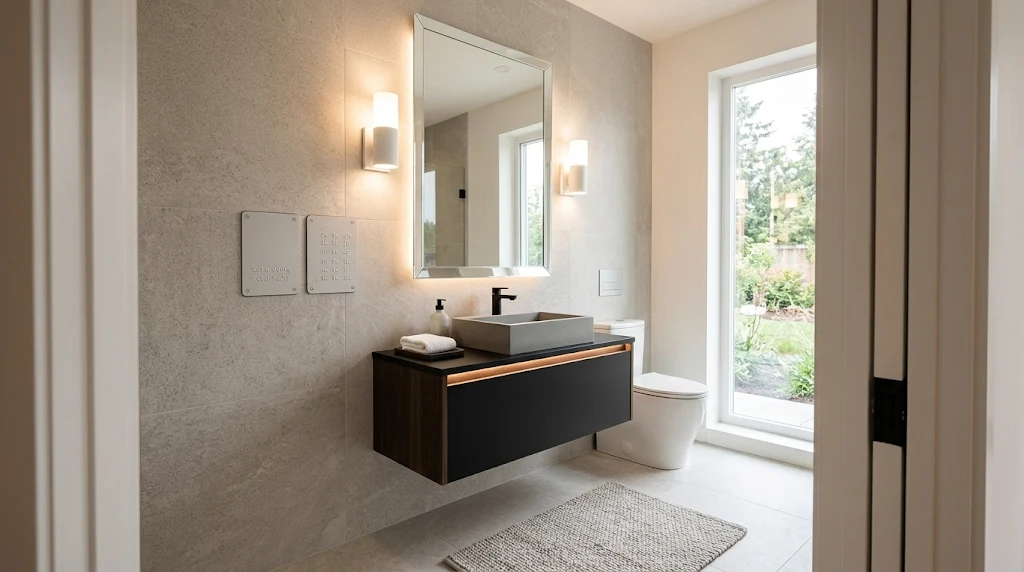

Small Bathroom Lighting: Fixture Placement, Layering, and Common Mistakes
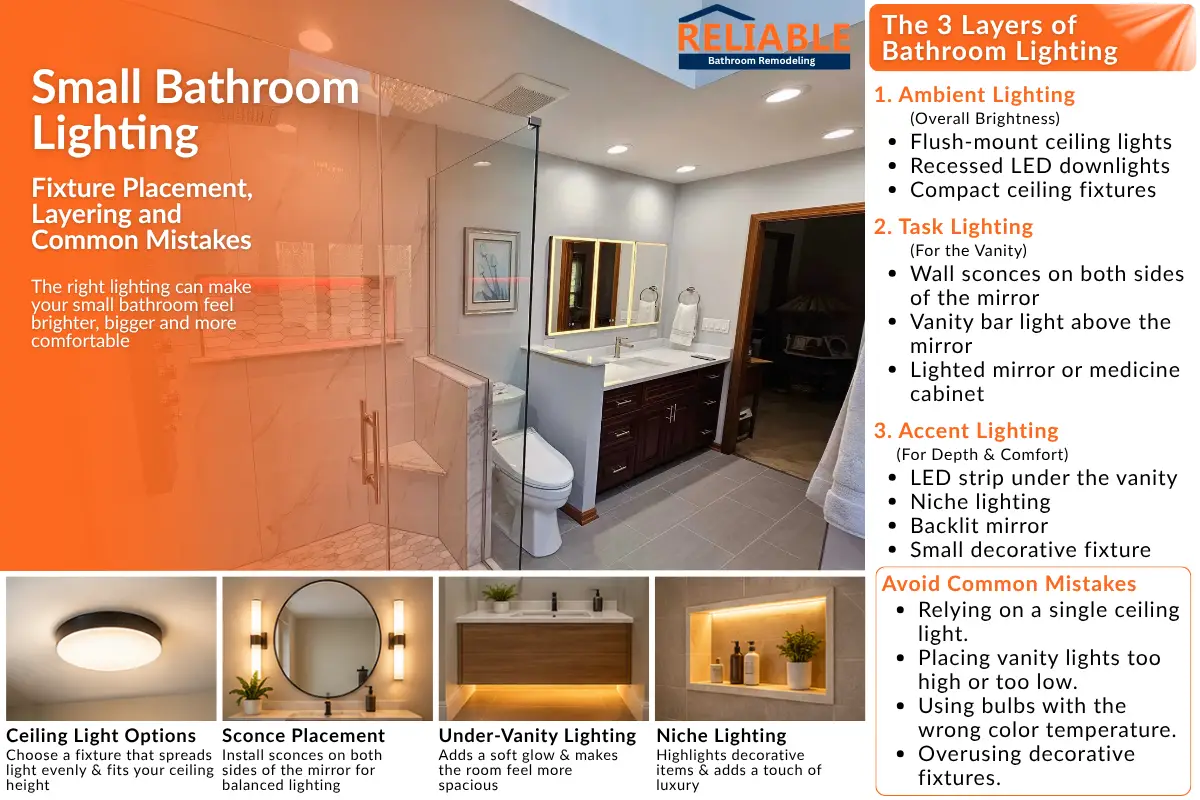
It is 6:45 in the morning.You are standing at a bathroom mirror the size of a cutting board, and a single bulb is burning straight down from the ceiling. Your eyes look like two dark caves, your chin has a mystery shadow, and the shave or makeup you are trying to do is basically guesswork. The room is small. The problem is not the room. It is where the light comes from. The right small bathroom lighting ideas can make even the tiniest bathroom feel brighter, more comfortable, and easier to use.
Small bathrooms are actually easy to light well because you need fewer fixtures. But each fixture matters more, and a couple of mistakes show up fast. From choosing the right fixtures to exploring practical small bathroom lighting ideas, this guide covers how to layer light, where to position it, which fixtures are safe near water, what bulbs to buy, and what common mistakes to avoid. Sources and prices were checked in November 2026.
Quick answer
Use three layers: soft general light from the ceiling, task light at the mirror, and a wet-rated light in the shower. For the mirror, two sconces mounted at about 60 to 66 inches from the floor beat a single bar above the glass, according to Mod Lighting. If you must use a bar above the mirror, hang it at about 75 to 80 inches. Choose damp-rated fixtures in the room and wet-rated ones inside the shower, use bulbs with a high color rendering index, and keep every bulb the same color temperature.
Why small bathrooms need a lighting plan
In a small room, light bounces off every surface. Pale walls and glossy tile spread it around, which helps. Dark finishes soak it up, which hurts. Many small bathrooms also have no window, so the fixtures have to do all the work, morning and night.
There is a second reason to plan. Water. Light fixtures in a bathroom live in humid air, and some live in the line of fire of a showerhead. That changes which fixtures are allowed and where. Getting this right on paper is cheaper than fixing it after the walls are closed.
The three layers of light
Professional designers split lighting into layers, and the idea works well in tiny rooms. You do not need many fixtures, but you do need each job covered.
| Layer | What it does | Typical fixture | Where it goes |
|---|---|---|---|
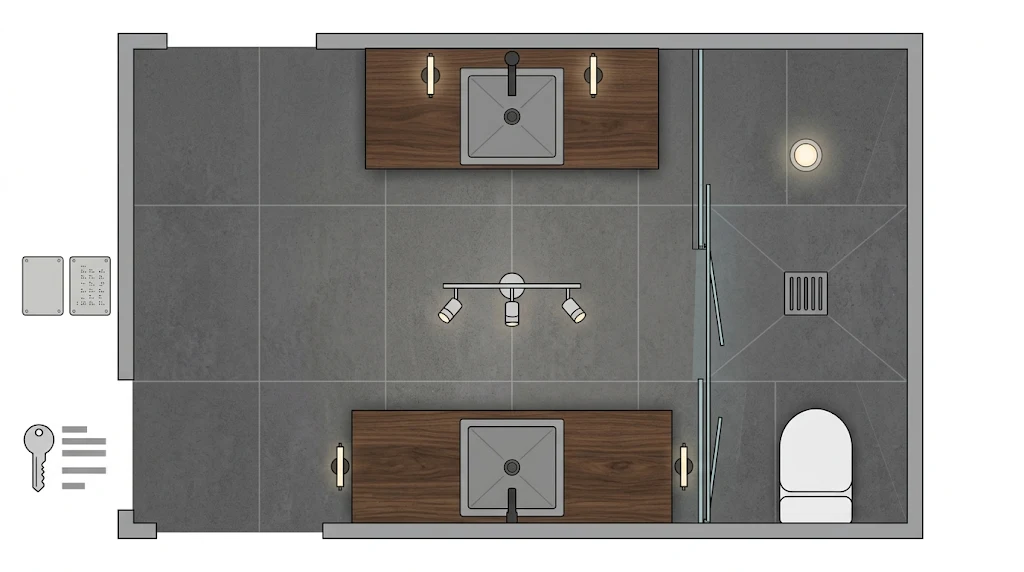
| Ambient | Soft, even light for the whole room | Flush or semi-flush ceiling fixture, or a recessed light | Center of the ceiling, or just outside the shower |
| Task | Clear, shadow-free light for grooming | Two sconces beside the mirror, or a bar above it | Flanking or above the mirror at the heights below |
| Wet-area | Visibility inside the shower or over the tub | Wet-rated recessed light | Over the shower, offset toward the entrance |
| Accent | Gentle night or mood light | Toe-kick strip, small wall light | Low on the vanity base or a wall |
The Hunker summary of the National Kitchen and Bath Association guidelines points the same way: it recommends task lighting in each functional area, such as the shower and the vanity, and says the safest way to light a shower is with a recessed light rated for wet locations. These are guidelines, not law, so your local electrical code has the last word.
Vanity lighting: sconces, bars and heights
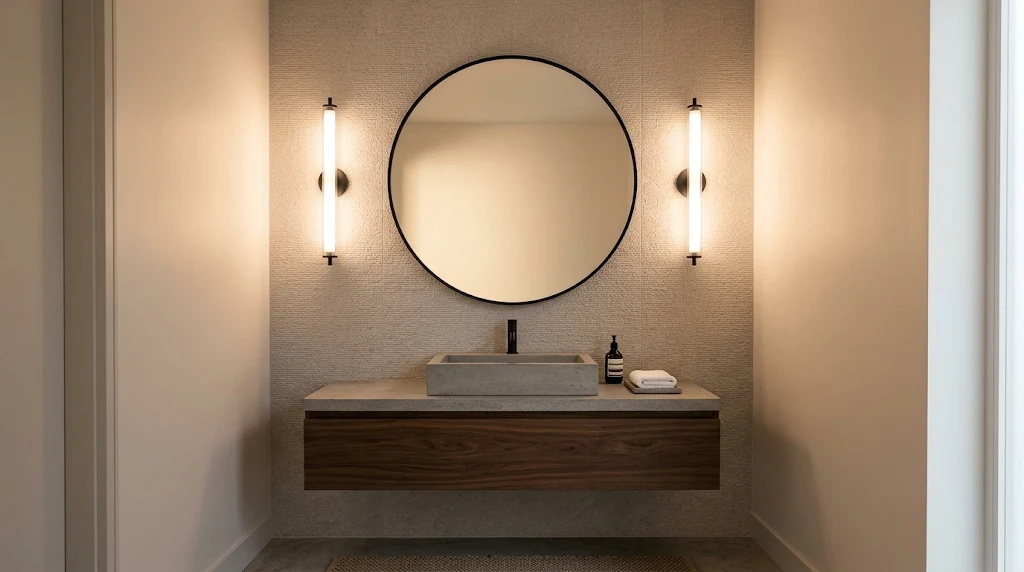
The mirror is where most people judge their lighting. The rule of thumb that appears in nearly every guide is to put light on both sides of the face. Mod Lighting explains that sconces on either side of the mirror light the face evenly, while a fixture mounted above the mirror casts shadows under the eyes and chin.
| Setup | Mounting height (to fixture center) | Spacing and size | Best for |
|---|---|---|---|
| Two sconces beside the mirror | About 60 to 66 inches from the floor | About 36 to 40 inches apart, per Mod Lighting; Golden Lighting suggests 24 to 36 inches overall, with each fixture 2 to 6 inches from the mirror edge | A mirror at least about 24 inches wide, with wall space on both sides |
| Bar above the mirror | About 75 to 80 inches from the floor | Fixture about 75 to 80 percent of the mirror width | Narrow rooms, wall-to-wall mirrors or no side wall space |
| Sconces mounted on the mirror | Center near eye level | Follow the mirror manufacturer’s instructions | Larger mirrors with built-in mounting |
You will notice the spacing advice varies. That is normal. Different guides assume different mirror widths, and the right gap depends on your mirror and the fixture size. Golden Lighting also notes that the American Lighting Association’s consumer guidance favors fixtures on both sides of the mirror, centered at eye level, since light from above casts shadows. Measure your own room, then adjust to the tallest regular user, because eye level is different for each person.
- Tiny half bath with a small mirror: one bar above the mirror at 75 to 80 inches is usually the realistic choice. Pair it with a ceiling light so the face is lit from more than one angle.
- Narrow vanity with room on both sides: choose slim sconces. A fixture only a few inches wide fits beside a mirror without crowding it.
- Round or large mirror: sconces on either side work, or consider an edge-lit mirror that spreads the light across the glass.
Shower and wet-area lighting
Lighting fixtures are rated for dry, damp or wet locations. Dry-rated fixtures are for ordinary rooms. Damp-rated ones tolerate humidity and condensation. Wet-rated ones can take direct water. According to a Virginia electrical contractor, fixtures inside a shower or tub enclosure must be wet-rated and enclosed, with GFCI protection, under the National Electrical Code, and any switch for them must sit outside the enclosure. Many other guides say fixtures elsewhere in a bathroom should be at least damp-rated, and some local codes are stricter. A common example is a decorative pendant that is rated for dry locations only.
Practical guidance:
- Inside the shower or directly over a tub: wet-rated, enclosed and GFCI-protected. A single recessed light is often enough in a small shower.
- Over the vanity and in the general room: damp-rated at minimum. Check the label or listing, not the look.
- Offset the shower light slightly toward the entrance rather than directly over the head, to reduce glare.
- Ask your electrician and local building department about the rules in your area, because codes differ by city.
Check the label
A fixture that looks like it belongs in a bathroom may not be rated for one. Look for the words damp or wet on the box or the listing before you buy, especially for decorative pendants and chandeliers.
Brightness, color and bulb quality
Fixtures get the attention, but the bulb decides how the light looks. Three numbers matter: lumens, color temperature and color rendering.
- Lumens (brightness). Lumens measure light output. As a conversion, Efficiency Vermont lists about 800 lumens as a 60-watt equivalent, 1,100 as 75-watt and 1,600 as 100-watt. Buy by lumens, not watts. For a vanity, you usually want plenty of light at the mirror, and a dimmer lets you turn it down at night.
- Color temperature (Kelvin). ENERGY STAR says 2700K is a warm, yellowish light and 4000K is a bright white. Many designers favor roughly 2700 to 3000K at the vanity for flattering skin tones, but this is a preference, not a rule. Whatever you choose, use the same Kelvin number in every fixture in the room, so the light does not look patchy.
- Color rendering (CRI). The U.S. Department of Energy says color rendition is generally considered more important than color temperature. ENERGY STAR-certified bulbs have a CRI of at least 80, and guidance from the Illuminating Engineering Society, as presented in an ENERGY STAR webinar, calls for 80 or better at home and 90 or higher where color matters. A mirror is such a place.
One more detail: if you are using dimmers, check that the bulbs and the dimmer are compatible, and use bulbs marked for enclosed fixtures if the fixture has a closed glass shade.
Sample plans for small rooms
These are examples to adapt, not rules. Each one covers all three layers.
| Room | Plan |
|---|---|
| Powder room or half bath (about 20 to 30 square feet) | One bar above the mirror at 75 to 80 inches, plus a small flush-mount ceiling light on a dimmer. |
| Standard 5 by 8 full bath | Two slim sconces beside the mirror at 60 to 66 inches, a ceiling light, and one wet-rated recessed light in the shower. |
| Windowless small bath | Add a second ambient source, such as a recessed light, and a dimmable toe-kick night light so you are not blasted at 2 a.m. |
| Narrow bath with a tub | Wet-rated recessed light over the tub, a bar above the mirror, and a flush ceiling light near the door. |
If you want ideas for how real rooms combine fixtures with tile and storage, browsing project photos for inspiration can help.
Common mistakes and quick fixes
| Mistake | Why it hurts | Fix |
|---|---|---|
| Only one light on the ceiling | Casts shadows on the face and leaves the room flat | Add task light at the mirror and a separate ambient layer |
| Bar mounted too high or too low | Creates shadows or glare and may show in the mirror | Keep it at about 75 to 80 inches, or switch to sconces at about 60 to 66 inches |
| Dry-rated fixture near water | Moisture can damage it, and it may fail inspection | Choose damp- or wet-rated fixtures and check the label |
| Mixed color temperatures | Light looks uneven, with some bulbs yellow and others blue | Use the same Kelvin number throughout the room |
| Oversized fixture | Crowds a small wall and dominates the mirror | Size it to about 75 to 80 percent of the mirror width |
| No dimmer | Too bright at night, too harsh for a quick trip | Put the ambient and vanity lights on dimmers |
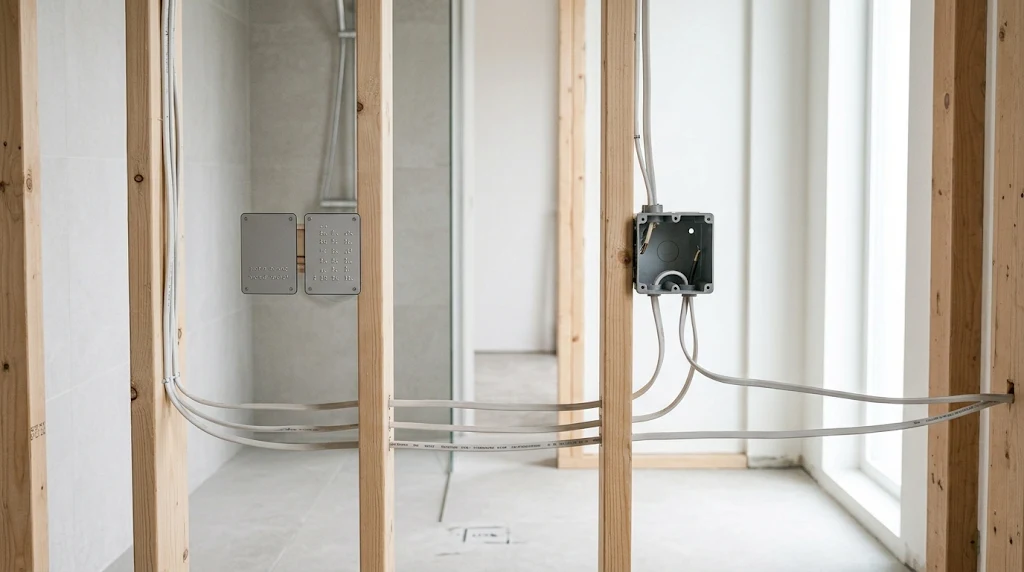
| Planning lighting last | Adding wiring after drywall costs more | Settle fixture positions before the electrical rough-in |
What lighting costs
Prices vary by location, and electricians price by fixture, wiring and access. According to Angi, installing a light fixture typically runs about $158 to $1,021, wall-mounted lights about $100 to $250, and about $100 to $200 extra if new wiring is needed. Angi also puts recessed lighting at roughly $200 to $250 per fixture installed. The fixtures themselves are a separate cost, and they range widely, so check whether a quote includes them.
| Item | Typical installed cost | Source note |
|---|---|---|
| Wall sconce or wall-mounted light | $100 to $250 each | Angi. Add about $100 to $200 if new wiring is needed. |
| Recessed light (for example in the shower) | $200 to $250 each | Angi. Wet-rated models may cost more. |
| Standard light fixture installation | $158 to $1,021 | Angi typical range, depending on type and work. |
| Dimmer switch (part only) | $6 to $40 | HomeAdvisor materials range. Labor is extra. |
As a rough illustration using my own arithmetic with those ranges: two sconces ($200 to $500) plus one recessed shower light ($200 to $250) comes to about $400 to $750 before new wiring and fixtures. That is a modest amount for the biggest improvement in how the room feels.
Plan it before the walls close
Lighting is a decision that has a deadline. In a remodel, electrical rough-in happens before the drywall goes up, so the positions of sconces, recessed lights and switches need to be locked in by then. Moving a sconce after the wall is finished can mean cutting and patching drywall. If you want a sense of how the stages line up, the trades that handle layout and wiring are worth reviewing before you finalize your plan.
This is also where the “while we’re at it” trap shows up in a helpful way. When the walls are open, adding a second sconce box or a dimmer costs very little. Adding it later costs a lot. If you are not sure you will want a nightlight or a toe-kick strip, have the electrician rough in the wiring, even if you install the fixture later.
For a rough idea of how lighting fits into the overall budget, see overall budget ranges, and if you have questions about permits and planning, the FAQ on planning and permits may help. Availability varies, so check where work is available before you ask for a visit.
Frequently asked questions
How high should I mount bathroom vanity lights?
For sconces beside the mirror, about 60 to 66 inches from the floor to the fixture center is the common guideline. For a bar above the mirror, about 75 to 80 inches. Adjust for the tallest regular user and your mirror height.
Is one light enough for a small bathroom?
Usually not. A single ceiling light often casts shadows on the face. Adding light at the mirror and a wet-rated light in the shower covers most needs.
Do bathroom lights need to be waterproof?
Fixtures inside a shower or over a tub need to be wet-rated. Fixtures elsewhere in the bathroom should generally be at least damp-rated. Your local code decides the details, so ask your electrician.
What color temperature is best for a bathroom?
Many designers use about 2700 to 3000K at the vanity for flattering light, but it is a matter of taste. ENERGY STAR describes 2700K as warm and 4000K as a bright white. Keep every bulb the same.
What is CRI and why does it matter?
CRI measures how accurately a light shows color on a scale of 0 to 100. It matters at a mirror, where you judge skin tone and makeup. ENERGY STAR-certified bulbs have a CRI of at least 80, and 90 or higher is often recommended where color matters.
Can I add bathroom lighting without opening walls?
Sometimes. Swapping a fixture in the same location is simple. Adding a new sconce or recessed light usually needs new wiring and drywall repair. It is best to plan lighting before the walls are closed.
Final thoughts
Good small bathroom lighting is not about more lights. It is about putting light where your face, your tasks and the water are. Cover the three layers, keep the colors consistent, use the right ratings near water, and settle the positions before the walls close.
If you remember one thing, make it this: light from both sides of the mirror, not from straight above. That single change fixes the shadows that make so many small bathrooms feel dim. Sources checked November 2026.
Planning new bathroom lighting?
Tell Reliable Bathroom Remodeling about your bathroom and ask for a free estimate. Ask for the lighting plan to be included in the scope, with fixture positions agreed before wiring begins.