
Walk-In Shower Cost in 2026: Installation, Tile, Glass, and Plumbing
You found a walk-in shower online for about $4,000. Then the first quote lands on the kitchen table at $13,500. You are not angry so much as confused, like someone moved the price tag while you were reading it.
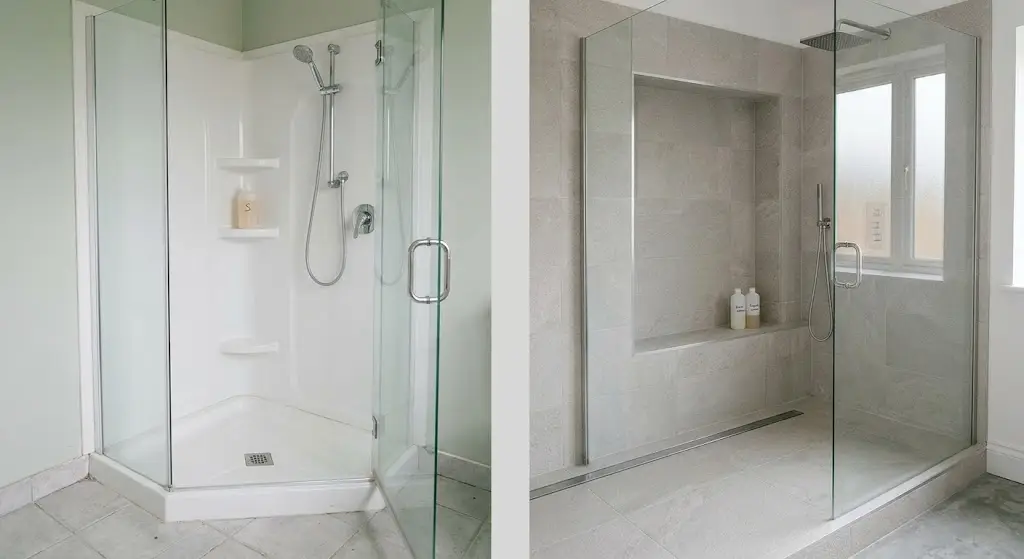
Here is the useful part: neither number is wrong. They describe two very different showers. One is a factory-made pan and wall kit dropped into an existing alcove. The other is a built-from-scratch tile room with a sloped floor, a waterproofing system, heavy glass and new plumbing. This guide breaks down what each part costs, where the surprises hide, and how to build a budget before anyone starts measuring. Prices and sources were checked in November 2026.
Quick answer
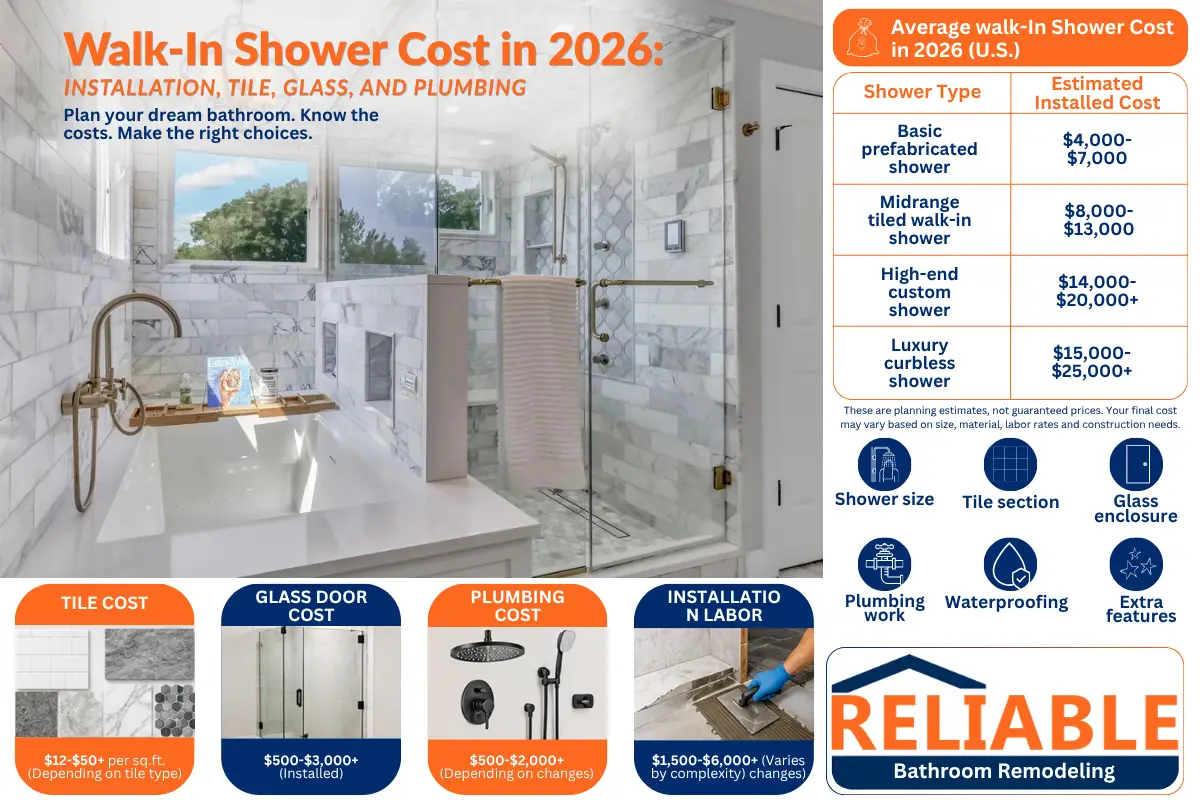
This Old House puts a walk-in shower at about $4,000 to $20,000, with a typical project near $12,000. A prefab install runs roughly $4,000 to $7,000, a midrange tiled shower about $8,000 to $13,000, and a high-end custom build $14,000 to $20,000 or more. Other sources run lower: Angi reported an average near $6,700 in earlier data. Tile, glass, plumbing changes and labor drive most of the spread.
Walk-in shower cost by project type
The biggest question is not which tile you like. It is whether the shower is a kit or a custom build. This Old House sorted 2026 costs into three tiers using national contractor cost data from Homewyse plus its own survey of homeowners.
| Project type | Typical installed cost | What is usually included |
|---|---|---|
| Basic prefabricated | $4,000 to $7,000 | Factory pan and modular wall surround in an existing alcove, minimal plumbing changes, framed glass or a curtain. |
| Midrange tiled | $8,000 to $13,000 | Ceramic or porcelain tile, tiled pan, waterproofing membrane, frameless or semi-frameless glass, plumbing mostly left in place. |
| High-end custom | $14,000 to $20,000 or more | Larger footprint, relocated plumbing, heavy frameless glass, bench and niches, premium fixtures, advanced waterproofing. |
Why the sources do not agree
If you search around, you will find lower and higher averages. Angi, using 2025 data, listed a walk-in shower average near $6,700 with a wide range from about $1,000 to $15,000, as cited in an earlier This Old House guide. Homeyou put a custom tile shower at about $6,000 to $15,900, averaging roughly $9,200. Those numbers sit below the $12,000 average above. My read is that the spread comes from what each source counts as a “walk-in shower”: some include simple kits and swaps, others only full tile builds. When you compare prices, check that you are comparing the same kind of shower.
Estimates, not quotes
Every figure in this guide is a national estimate. Labor rates, permit fees and material prices vary by state and city, and your bathroom’s condition changes the scope. Use these numbers to plan, and use an itemized written quote to decide.
Where the money goes
A walk-in shower is a handful of separate jobs that happen to share one footprint. This Old House lists installed price ranges for the main components, which helps explain how a bill reaches five figures.
| Component | Typical cost |
|---|---|
| Ceramic or porcelain tile (installed) | $12 to $30 per square foot |
| Natural stone tile (installed) | $20 to $50 per square foot |
| Prefabricated shower pan | $800 to $1,500 |
| Custom tile shower pan | $1,200 to $3,000 |
| Backer board and waterproofing system | $800 to $1,500 |
| Framed glass shower door | $500 to $1,200 |
| Frameless glass enclosure | $1,000 to $3,000 or more |
| Shower valve and trim kit | $500 to $1,200 |
Labor is the quiet driver. In This Old House’s 2026 survey of homeowners who added a walk-in shower, 56% said labor was a major contributor to their total. That makes sense. A tiled shower involves demolition, plumbing, framing, waterproofing, tile and glass, and each trade has to wait for the one before it. More steps and more waiting mean more billable hours.
That survey also showed that walk-in showers are often part of a bigger job. About 67% of those homeowners included plumbing work, 60% included tile, and 51% included electrical updates. If you want a sense of how a full scope looks in practice, browse photos of finished showers and note how many separate materials appear in each.
What tile really costs
Tile is priced per square foot, so the real question is how many square feet your shower has. Here is a worked example using my own arithmetic. Take a common 60 by 36 inch alcove with tile run to a 7 foot height on three walls, plus the floor.
- Back wall: 5 feet by 7 feet is 35 square feet.
- Two side walls: 3 feet by 7 feet each is 42 square feet.
- Floor: 5 feet by 3 feet is 15 square feet.
- Total: about 92 square feet, before waste and trim.
At the installed ceramic or porcelain range above, that is roughly $1,100 to $2,800. At the natural stone range, it is roughly $1,800 to $4,600. Add a niche, a bench or a decorative border and the number climbs, because each one adds cutting, leveling and time. This example ignores waste, which is usually extra, so treat it as a floor, not a ceiling.
Small wins that save money
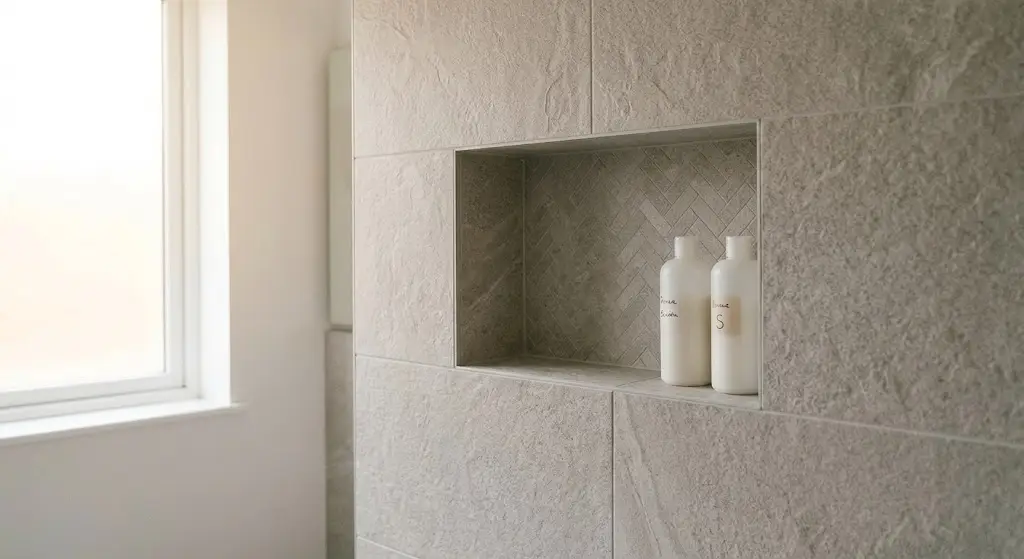
Larger tiles mean fewer grout lines and faster setting, but they need a flat wall. Simple patterns cost less to install than herringbone or mosaics. An accent strip in a premium tile gives you the look of luxury across a small area.
Glass: framed, frameless and panels
Glass is the easiest place to overspend or underspend, because the range is wide. By This Old House, a framed glass door costs about $500 to $1,200, while a frameless enclosure costs about $1,000 to $3,000 or more. Independent sources land in the same neighborhood for door installation: Angi cites roughly $550 to $1,400, and Homeyou cites about $540 to $1,400.
Why the gap? Frameless glass is thicker tempered glass with heavier hardware, and it has to be cut to your exact opening. Glass side panels are thicker than ordinary sheet glass and can add cost too, according to Bob Vila’s overview of walk-in showers. The glass is usually made to measure after the tile is set, so ordering early and confirming the measurements matters.
A practical way to save here is to choose semi-frameless or framed glass and put the upgrade money into the tile or the valve instead. People notice a beautiful wall every day. They notice the difference between framed and frameless much less.
Plumbing, drains and curbless designs
If the shower goes where the old tub or shower already was, the plumbing can often stay. If it moves, costs rise. Angi’s shower remodel guide lists new plumbing at about $600 to $3,500. This Old House adds that relocating drains or supply lines also means more labor hours and coordination between trades.
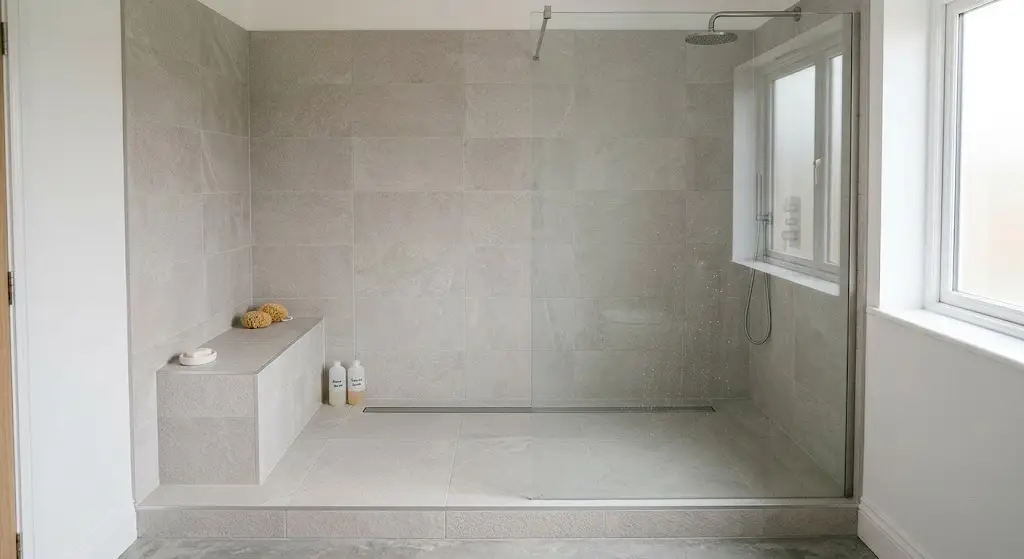
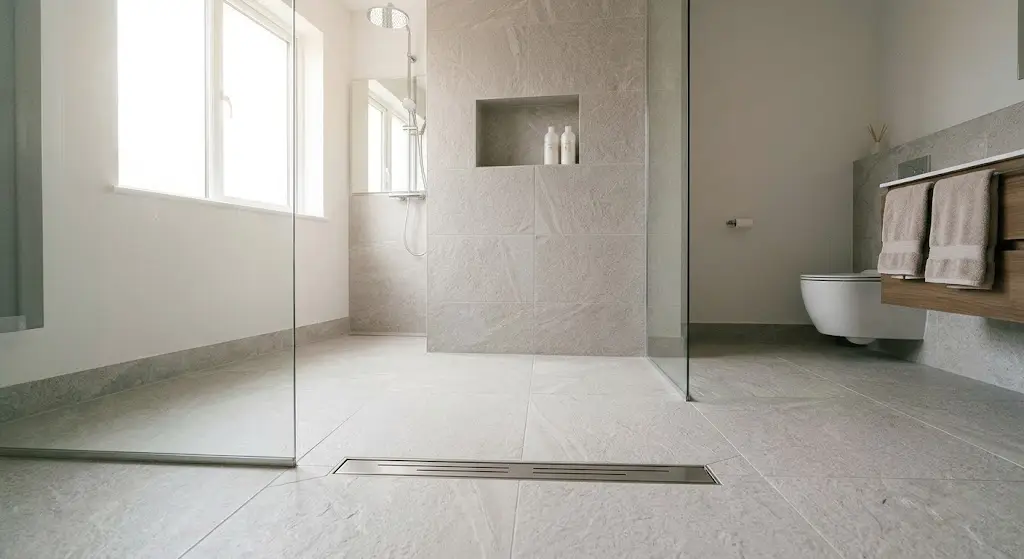
A curbless or roll-in design pushes costs up for a different reason. The floor has to slope toward the drain without a curb to hold the water, which usually means modifying the subfloor and extending the waterproofing. The result is a clean, accessible entry, and it is a common choice for people planning to stay in their homes long term. Angi estimates accessibility features add roughly $75 to $1,900 to a walk-in shower. If you want to explore it, see flush-entry shower projects.
This is also the stage where an old house can surprise you. In the This Old House survey, about 31% of walk-in shower projects were in homes more than 20 years old, where plumbing and framing problems are more likely to turn up once the walls are open.
Build your own estimate
Here is a quick way to sanity-check a quote. Add up the main components from the table above for a midrange tiled shower, using the 92 square foot example. This is my own arithmetic with the published ranges, and it deliberately leaves some items out.
| Item | Low | High |
|---|---|---|
| Tile, 92 sq ft installed ($12 to $30) | $1,104 | $2,760 |
| Custom tile pan | $1,200 | $3,000 |
| Backer board and waterproofing | $800 | $1,500 |
| Framed glass door | $500 | $1,200 |
| Valve and trim kit | $500 | $1,200 |
| Subtotal with framed glass | $4,104 | $9,660 |
| Swap in a frameless enclosure ($1,000 to $3,000) | $4,604 | $11,460 |
This subtotal leaves out demolition, disposal, plumbing changes, electrical, permits and any repairs. Those extras are what push a midrange shower toward the $8,000 to $13,000 tier. If a quote is far below the low end, ask what is missing. If it is far above the high end, ask which line items account for the difference.
Costs people forget
- Permits and inspections. This Old House says permit fees vary by city but can add several hundred dollars when plumbing or structural changes are involved. Ask your local building department what applies.
- Demolition and disposal. Removing an old tub or shower, hauling debris and fixing what you find behind the wall is rarely free.
- Repairs behind the wall. Rot, mold or outdated pipes are the classic surprise. Remodelers such as USA Cabinet Store suggest a contingency of 10 to 20 percent for homes built before 1990.
- Time. Among the homeowners surveyed by This Old House, 37% said a renovation that included a walk-in shower took three to four weeks, and 22% said one to two months. Plan for a stretch without that shower.
Now the “while we’re at it” trap. Once the wall is open, adding a bench, a second niche or a body spray feels almost free, because the demolition is already paid for. It is not free. Each addition brings its own materials, labor and lead time. Decide the extras before demolition, then treat anything new as a separate decision. If you want to see which trades sit under one schedule, look at the range of remodeling work available.
How to lower the bill without cutting corners
- ☐Keep the shower where the old plumbing is. This Old House says reusing the existing footprint reduces complexity.
- ☐Consider a prefab base and surround if you want the lowest cost, or a tiled pan with a prefab-style wall system for a middle path.
- ☐Choose ceramic or porcelain tile over natural stone.
- ☐Pick framed or semi-frameless glass unless the frameless look is a priority.
- ☐Limit structural changes such as moving walls or enlarging the footprint.
- ☐Finalize the design before demolition and avoid mid-project changes.
- ☐Never save money on waterproofing. A leak behind finished tile costs far more than any shortcut saves.
For a rough starting point on budget, see ballpark project prices, then compare it against the written scope you receive. Prices also vary across regions, so check the service area list for coverage.
Frequently asked questions
How much does a walk-in shower cost in 2026?
Based on This Old House’s 2026 guide, about $4,000 to $20,000, with a typical project near $12,000. Prefab installs sit at the low end and custom tile builds with frameless glass sit at the high end. Other sources report lower averages, so use a range, not a single number.
Why do online prices differ so much?
Because “walk-in shower” covers everything from a kit to a custom tile room. Some averages include simple installs and others count only full builds. Compare the scope line by line.
How much does a prefab walk-in shower cost installed?
This Old House puts basic prefab installs at about $4,000 to $7,000. Angi lists the prefab unit itself at roughly $700 to $3,000, so the rest of the price is labor and related work.
How much does frameless glass add?
The component ranges above show a frameless enclosure at about $1,000 to $3,000 or more versus $500 to $1,200 for framed glass. That is often $500 to $2,000 or more extra, depending on size and hardware.
Does a curbless shower cost more?
Usually yes, because the floor needs slope work and extra waterproofing. The extra cost is worth weighing against easier access and a more open look.
Can I install a walk-in shower myself?
Simple prefab installs are possible for experienced DIYers, but This Old House recommends a professional for custom tile or plumbing changes, since poor waterproofing or drainage can cause water damage. In its survey, only about 20% of walk-in shower owners did most or all of the work themselves. Check permit rules with your local building department.
Final thoughts
The walk-in shower cost you see first is almost never the one you pay, because the word covers too many different projects. Decide whether you want a kit or a custom build, choose where to spend on tile and glass, and protect the part nobody sees: the plumbing and waterproofing behind the finish.
If you remember one habit, make it this: ask for an itemized written scope, and compare it to the component ranges above. A clear line-by-line estimate turns a scary total into a list of decisions you can actually make. Questions you want answered first may already be covered in the homeowner FAQ page. Sources checked November 2026.
Want an itemized price for your shower?
Tell Reliable Bathroom Remodeling about your bathroom and ask for a free estimate. Share the size, your tile and glass ideas, and whether the plumbing needs to move.